

Blog

Is marriage counseling your last resort? 3 reasons it should be your first defense
The average couple waits 6 years before starting marriage counseling. That’s 6 years of unhappiness. 6 years!? That’s like earning a Bachelor’s and Master's degree in unhappiness! I just can’t fathom being unhappy for that long and those are not degrees I want to earn.
Waiting that long and doing some of the aforementioned things to try and work on the issues is like receiving a cancer diagnosis, being told by the doctor that the remedy is chemo and/or radiation, but deciding to take vitamins to try and see if that helps for a couples of years before bringing out the big guns and doing the prescribed treatment.

“If this doesn’t work, then our next option is probably divorce.”
I hear this time and time again when new couples come into my office to work on their relationships. While I am trained in Discernment Counseling, I am still surprised at the number of people who use therapy as a last resort.
One of the questions I ask these couples is, “what have you done either individually or as a couple to work on some of the issues so that it didn’t get to this point?”
The answers are typically: more of the same, talk about not fighting, read a book, or made some behavioral changes that lasted a few months before old patterns started to return.
The average couple waits 6 years before starting marriage counseling. That’s 6 years of unhappiness. 6 years!? That’s like earning a Bachelor’s and Master's degree in unhappiness! I just can’t fathom being unhappy for that long and those are not degrees I want to earn.
Waiting that long and doing some of the aforementioned things to try and work on the issues is like receiving a cancer diagnosis, being told by the doctor that the remedy is chemo and/or radiation, but deciding to take vitamins to try and see if that helps for a couples of years before bringing out the big guns and doing the prescribed treatment.
You’d likely resort to chemo much sooner than later and this is how you should also view couples therapy.
Couples Therapy should be your first line of defense because:
The problems can be resolved much quicker.
When you choose the wait-and-see method and things don’t get resolved, people start to build resentment, and resentment is like poison for a relationship. It festers and causes a deep wedge between partners that takes much longer to resolve when couples wait to start therapy.
Couples are more likely to experience lasting change.
When couples come in sooner they learn to solve their problems, and learn to communicate in ways they haven’t before. When couples enter couples therapy sooner they are able to gain tools that they can pull from their toolbox for years to come which leads to lasting relationship satisfaction.
The length of therapy tends to be shorter, and thus less expensive in the long-run.
When couples come to therapy sooner there’s less “undoing” of negative patterns in most cases, and that leads to a shorter course of treatment.
On average I tell couples they should plan to be in therapy for at least 6 months, however, when couples come in for premarital counseling I generally see them for less than 6 months. Learning and implementing new skills takes much less time than undoing the damage that’s been caused by years of negative feelings and arguments in addition to learning new skills.
If you’ve been waiting for the right time to jump into marriage counseling with your partner, the time is now! Feel free to reach out and schedule a free phone consultation and get back on track - the sooner the better.
5 Reasons to Schedule Sex this Holiday Season
Buy Christmas gifts. Decorate the Christmas tree. Grocery Shopping. Gingerbread house. Cookie baking. Company Christmas Party… and the list goes on. But is sex on the list? Do you have that scheduled this week?
Most people don’t. It’s not considered sexy by many, but here are 5 reasons you should:
Buy Christmas gifts. Decorate the Christmas tree. Grocery Shopping. Gingerbread house. Cookie baking. Company Christmas Party… and the list goes on. But is sex on the list? Do you have that scheduled this week?
Most people don’t. It’s not considered sexy by many. However neither is the frustration that comes with a sexless marriage. It may seem like the spontaneity becomes lost in the relationship once you begin scheduling sex, but here are 5 reasons you should be scheduling sex this season:

It gives you something to look forward to.
Studies show that the anticipation and planning of a vacation create more happiness than the actual vacation itself. I believe that this is because we love having things to look forward to. This season can be busy and stressful, but having a time set aside that you know you and your partner are going to connect physically and emotionally can help alleviate some of that stress.
Sex alleviates stress.
With all that you have on your to-do list this season it can be incredibly stressful, but sex is a physical way to alleviate stress and the added bonus is that you are also connecting with your partner. The cortisol flush you get when you orgasm helps to relieve stress.
The anticipation can be a major turn on.
When you are anticipating on the connection with your partner and vice versa it can
lead to some fun, playful, and racy communication. Fun text messages, flirtation, and
physical playfulness is a major turn on that keeps you connected between your
scheduled sex session.
Scheduling sex shows that your physical relationship with your partner is a priority.
We schedule doctor and dentist appointments, and we even leave work early and fight
traffic to get there, and those are the things that we don’t even necessarily want to do!
When you talk about making your sex life a priority with your partner that
communication is connective and lets them know that even though life is busy, it’s not
too busy to prioritize the most important relationship in your life.
Scheduled sex often leads to more spontaneous sex.
I get that you may not always be in the mood, but once you get going it feels like less
of a chore, I promise! Having a time to regularly connect physically means that you are increasing those good hormones that sex creates and you’ll likely find yourself wanting sex more often. The female libido is much different than the male libido, and women take a little longer to warm up, so talking about and making sure you have more foreplay before you do the deed will create more satisfaction and enjoyment.
I’m not sure what you’re still doing here - go schedule some sex with your partner! Remember that just because sex is scheduled doesn’t mean it has to be boring or routine. Do things to spice it up, play, and have fun with your partner.
If you’re having trouble getting things going in the bedroom, and are afraid that there’s issues that are running too deep to even get to a place where you’re able to schedule sex, I totally get it, and I’m totally here for you! Don’t hesitate to reach out and schedule a free, 15-minute phone consultation.

Filling the Emotional Bank Account - Part 2
This week I’m going to give you three more ways to make those deposits into the Emotional Bank Account and keep your marriage strong.

Have you been making bids for connection with your partner this past week? Do you have any idea what I’m talking about? If not, be sure to check out last week’s post where I discussed the Emotional Bank Account, and reciprocating bids for connection as a way to make deposits.
This week I’m going to give you three more ways to make those deposits. So without further ado, let’s just dive right in.
The second way to make deposits into the Emotional Bank Account is by speaking your partner’s Love Language.
Have you heard of The 5 Love Languages? It’s a great book, and an awesome concept by Gary Chapman. He teaches couples about the different ways to give love and to show love in relationships.
If you haven’t read the book, I’ll give you the quick Cliff’s Notes version: We all have ways that we give love and ways that we interpret love, and many times those two things are different, which is why it is important for us to understand the different languages.
The Five Love Languages are:
Gifts: you interpret your partner loves you when they give you gifts
Quality Time: you interpret your partner loves you when they spend time with you
Words of Affirmation: you interpret your partner loves you when they give you verbal compliments
Physical Touch: you interpret your partner loves you when they are physically affectionate with you
Acts of Service: you interpret your partner loves you when they go out of their way to do things for you such as making you a lunch, cleaning up around the house, etc.
If you haven’t already, you can go online to 5lovelanguages.com and take the quiz for free, and find out which one you most closely identify with. You also want your partner to take the quiz so that you can begin speaking one another’s love languages. When you show love in a way that your partner can hear, the results are so amazing! You feel heard and understood, and your connection will increase.
A third way to make deposits into the Emotional Bank Account is by creating a culture of appreciation in your home.
What I mean by this is, letting your partner know that you appreciate the little things they do and say.
It can be easy to point out the things they aren’t doing, and criticism can cloud the relationship, which is the opposite of what you want your partner to feel. By creating a culture of appreciation you are putting the things you appreciate at the forefront. Practice saying thank-you for the little things, let your partner know they are seen, and make deposits into the Emotional Bank Account.
The fourth way to make deposits into the emotional bank account is by nurturing your friendship.
We give our friends an awful amount of grace, but many times we aren’t so graceful with our partner.
For example, if you are going to meet a friend for a drink or coffee, and while you’re on your way your friend calls with an emergency, and says they aren’t going to be able to make it, typically you’d say, “ok, I hope everything is ok, and we’ll catch up next week.”
However, if you had plans to meet with your partner and you get a similar call, you may not be so nice in your response. (You can check out this post where I go more in-depth about this concept.)
I always ask the couples I work with what they are fighting about. When I hear responses like, “we fight over stupid little things,” or “we don’t even really know what starts the fights, they just seem to escalate,” my next questions are about ways they may or may not be nurturing their friendship.
When the friendship comes first, it’s easy to give grace, be forgiving, and not sweat the small stuff. If you’re looking for ways to nurture your friendship, think back to when you were first dating - what did you two like to do together? Get back to those things, or try new things. Get on Groupon or LivingSocial and find some new date ideas. Get out of your comfort zones together, laugh, and reconnect. This is the best way to build trust and connection.
If you and your partner seem to be missing the mark when it comes to filling the Emotional Bank Account, I’d love to hear from you. You can set up a phone consultation and we can talk about ways couples therapy might benefit you.

Filling the Emotional Bank Account
One of the best ways to make a deposit in the emotional bank account is by reciprocating bids for connection from your partner. Keep reading to learn more about filling the emotional bank account and keeping your marriage strong!
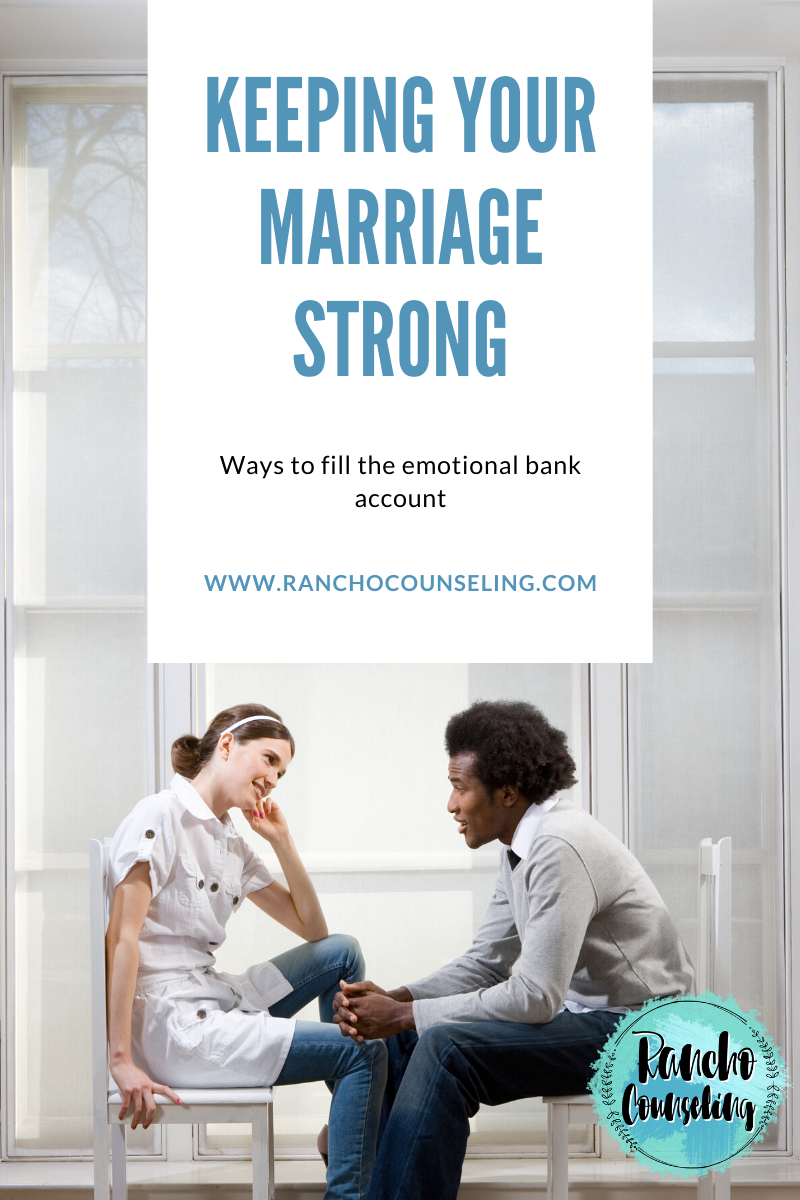
I hope you’ve never had the experience of walking up to the ATM and attempting to withdraw cash, only to be denied because your balance is too low...womp, womp. It happened to me once as a broke college student in my 20’s, and I can recall vowing to never let it happen again - the feeling was just so disheartening! I also hope this doesn’t happen to you in your relationship.
The emotional bank account is a lot like a regular bank account - if there’s nothing in it, there’s nothing to withdraw. When there’s nothing to withdraw, attempting to make a withdrawal tends to create more issues.
Let me give you an example: Joe is down and out on his luck, his bank account is overdrawn, and he’s been late a few times to work recently. He’s driving to work, and unfortunately he gets a flat tire. He starts to panic. He knows he’s already been late, and his boss has been on his back, so he is anxious about having to call in with this emergency that is going to make him late, yet again. Not only is he going to be late again, he is going to have to call his brother and ask him for some help since he doesn’t have the money to fix his tire at the moment.
A flat tire is a nuisance. It’s not something we like dealing with, but it’s also not the end of the world. It’s something most people have experienced at least once in their lives. Typically you just get it fixed and move on.
When you don’t have deposits in the emotional bank account, your experience can be much like Joe’s. Something small may come up - a spat, a conflict, a tough decision that you and your partner need to navigate, but when there’s nothing to draw from to offset this difficulty, it can lead to bigger issues. Suddenly this small inconvenience turns into a snowball of conflict and you find yourselves bringing up all of the past arguments you’ve had, and a rush of negative feelings comes in. Something small becomes something difficult and takes much longer to recover from than necessary.
So how do you make deposits into the emotional bank account?
I’m so glad you asked! ;)
One of the best ways to make a deposit in the emotional bank account is by reciprocating bids for connection from your partner.
A bid for connection is very simple, and we are continuously making them throughout the time we spend with our partner. Put simply, a bid for connection is any time you reach out to connect to your partner. When you walk into a room and say hi, when you point out something you see out the window, or comment on your sister-in-law’s latest facebook post.
As human beings we are wired for connection, and we especially want to connect to our partners in our romantic relationships. But when we make a bid for connection, we expect a response, and that response is when our partner either turns towards us, or turns away from us.
Turning towards and turning away doesn’t mean you necessarily have to physically turn towards or away from your partner, but the feeling is the same. If your partner looks out the window and says, “wow, there’s a lot of birds outside!” In that moment you can say, “oh, wow,” (turn towards him/her), or you can keep scrolling on your phone (turn away).
Dr. John Gottman says that we need a 5:1 ratio to keep our relationships healthy. So for every time you turn away and don’t reciprocate your partner’s bid for connection, you need to turn towards them five times.
Bids for connection happen really fast, and so you must be cognizant of whether or not you’re reciprocating and turning towards your partner. When we don’t keep this 5:1 ratio and don’t turn towards our partner, it leads to feelings of separation and loneliness.
Now that I’ve given you something to think about, and one way to make deposits into the emotional bank account, go out and pay attention to your partner’s bids for connection! Next week I’ll share a couple more ways to make those deposits. Or if you’re impatient and want all of the answers now (you’re my kinda person), you can check out my youtube video here where I share 4 ways to make deposits into the emotional bank account and keep your relationship healthy.
If you have questions, or are having difficulty feeling like your emotional bank account is full, please reach out to me! I’m always happy to answer your questions, or provide you with a free phone consultation to see if therapy is the next best step for you and your partner.

It’s not about the F*%$&@ Dishes
When couples come to my office and I bare witness to their arguments over minute things like housework it can be incredibly telling about the state of their relationship. It’s rarely about the dishes, the dirty clothes, or your partner’s decision to move the furniture around without consulting you first.
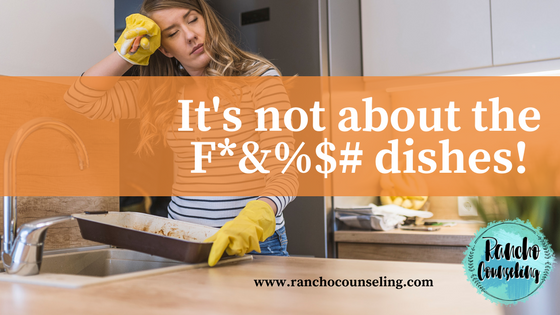
In the last 10 years in my work as a therapist I’ve heard couples argue about some of the most serious issues. I’ve also heard an equal amount of arguments over the most ridiculous things. The most common, yet benign argument, is over housework.
John Gottman says that 69% of marital problems are perpetual issues that will never be solved. This means that you really need to figure out a way to keep the peace and ride the waves of the perpetual problems.
When couples come to my office and I bare witness to their arguments over minute things like housework it can be incredibly telling about the state of their relationship. It’s rarely about the dishes, the dirty clothes, or your partner’s decision to move the furniture around without consulting you first.
When people dig their heels in and fight tooth and nail over who doesn’t clean up after themselves I think to myself, 1) who cares about the dishes?? and 2) what’s this really about? And those are things that I will quickly verbalize.
99.9% of the time when I call couples out on what they’re arguing about they will admit to me that it’s really not about the dishes.
In order to get there I ask questions like, what’s really under your ager over the dishes, why is this so important to you, and what feeling or thought comes up for you when you see your partner’s dirty dish in the sink?

That’s when I hear the translation: “you’re not on my team,” or, “you don’t have my back,” or “I feel like I’m just here to clean up after you (which translates to: we aren’t spending any quality time together).”
I’ll be honest with you – for the last 8 years of my marriage one of our perpetual problems has also been housework (which is why I finally hired a housekeeper).
I call this the dirty sock test (because that’s our issue): On any given day as I am picking up around the house I can find my husband’s dirty black socks strewn around like I’m on an Easter egg hunt. I know this about him – he sits down, removes his socks, and kicks them to the side, and there they stay until he or I come around and clean up. I’ve spent 9 years living with this man, I know that’s his habit, we all have them and I know I’m far from perfect – we said for better or worse, right?
But if I happen to be picking up the house and I bend down to pick up a few dirty socks and also happen to find myself whispering expletives under my breath, I know that my love tank is empty and he hasn’t been speaking to me in my love language, and I it’s time to ask for what I need. What I might think I need is for him to pick up his damn socks, but what I truly need is much more than that (it's usually quality time).
Nobody gets that angry over a pair of dirty socks (or dishes, or furniture, or tardiness) unless there’s something under that anger - the socks just happen to be the blister on the surface.
So when you’re ready to snarl, retreat to your corner, send a snarky text or give an obvious eye roll, it’s time to check yourself and ask, what’s this really about?
Another way to think about this is to ask yourself, “if my best friend left their socks behind, (left a dish in the sink, or was late for plans) would I blow up?” More than likely it would just roll off your back and you wouldn’t think twice about it.
We give our friends a great deal of grace. But when you aren’t nurturing your friendship with your partner its easy to fight about the little things.
So what’s it really about? Are you resentful over something that’s missing in your relationship? Those conversations might be more difficult to have, but I’m happy to help. You might not get over those perpetual problems in marriage, but when you’re free from resentment it makes it so much easier to be friends - even if they don’t get around to washing their dishes a couple times a week. You can click here to book a consultation with me and we can talk about how couples therapy might help.