
Blog
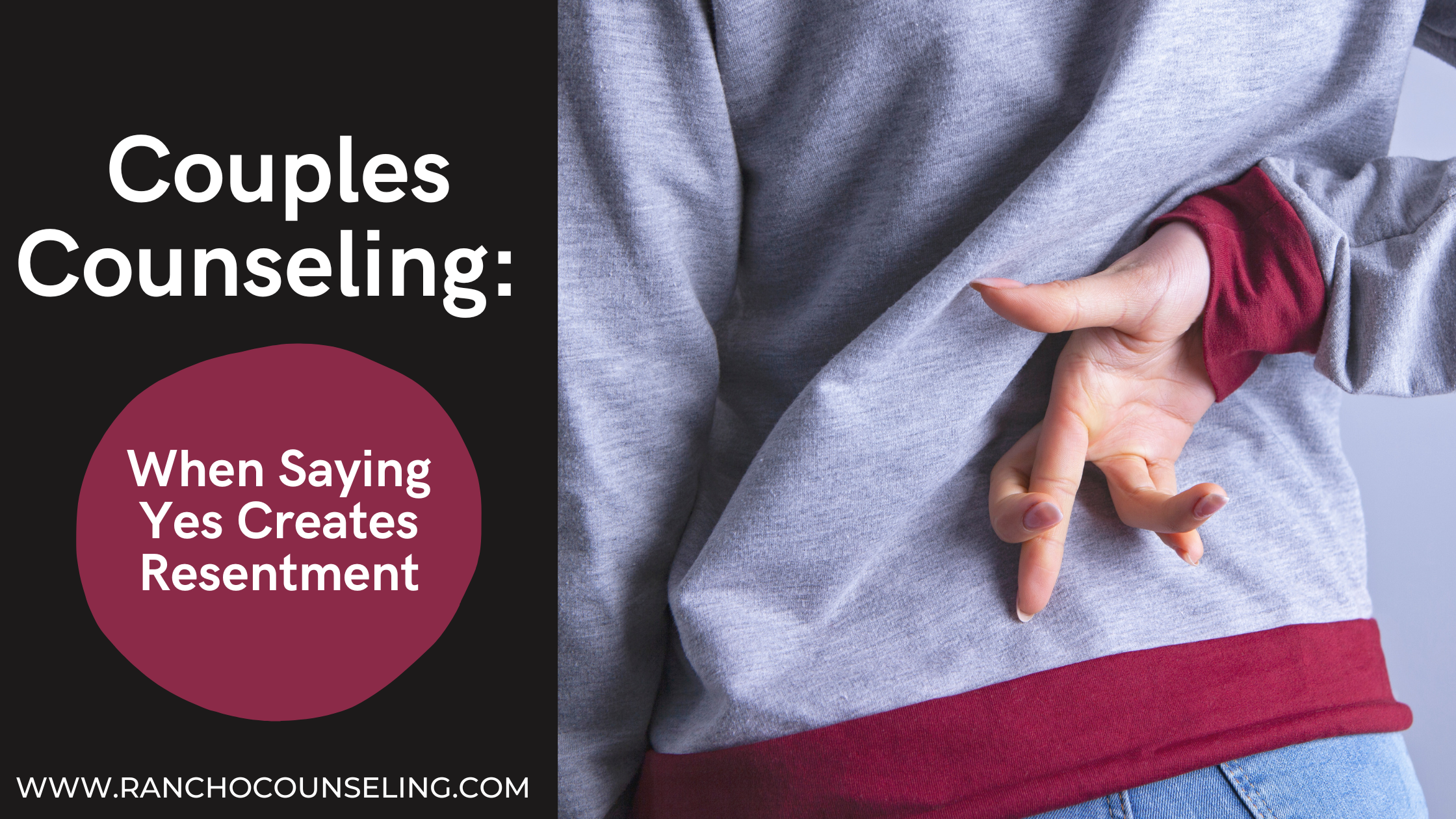
Couples Counseling: When Saying Yes Creates Resentment
Are you saying yes when you really mean no? Avoiding conflict may feel easier in the moment, but it often creates resentment and emotional distance. Learn how couples counseling can help you communicate more honestly and strengthen your relationship.

The other day, my 6-year-old daughter asked me to do a craft with her. I had a whole list of to-dos that I wanted to get done that day, and I knew if I didn’t get started early, I’d never complete all the things on my list.
She begged and pleaded with me, and I gave in. We made an origami sword that she ended up being obsessed with. She said it made her feel so powerful.
I wish I could say it was a great activity and that it was totally worth pushing off my to-do list for.
But unfortunately, that wasn’t the case.
She asked me to do a craft with her, but I ended up doing it for her. She did some cutting and project management, but it was an involved process that included many folds, multiple papers, and a glue gun. It was not something she could have completed on her own.
I begrudgingly folded and glued, and even though she came with excitement and encouragement, I was resentful.
I felt the annoyance radiating through my body, and it didn’t allow me to show up with an open heart. I was short and uninterested. It wasn’t what she deserved. It wasn’t even her fault. It was mine.
I had said yes when I meant no.
The entire project took maybe 30 minutes, but the entire time I was distracted thinking about what I needed to get done before we headed out on our camping trip the next day. I was grumpy and didn’t appreciate her enthusiasm and sweetness.
When it was finished, I totally regretted my withdrawn attitude.
That’s not how I want to show up in my relationship with her.

How Avoiding Conflict Creates Resentment in Relationships
That’s not how any of us should show up in our relationships, but it’s how I see so many couples show up toward one another.
As a therapist who provides couples counseling, I often see resentment growing when people say yes when they really mean no. We convince ourselves we're being kind, accommodating, or keeping the peace. But underneath the surface, resentment begins to build.
And when we feel resentful, it impacts our mood, our communication, and the way we approach the people we love most.
I was withdrawn with my daughter and unappreciative of her excitement.
How many times have you begrudgingly attended an event with your partner and looked for any reason not to have a good time?
You might drag your feet and show up late. You might nitpick the food, criticize the company, or find fault with your partner throughout the evening.
When we say yes when we mean no, it often leads to passive-aggressive behavior, emotional distance, and resentment. Ironically, the very conflict we were trying to avoid often becomes much bigger later.
Why Couples Avoid Difficult Conversations

So why do we do it?
Most people do it to avoid conflict.
Many people also do it because they don't want to disappoint their partner. Others do it because they feel guilty about something that happened in the relationship and believe they need to make up for it by always saying yes.
This is especially common after a betrayal, breach of trust, or major relationship conflict.
If you feel like you have to go along with whatever your partner wants because you made a mistake in the past, there is really no amount of people-pleasing or good deeds that will repair the relationship.
Healthy relationships aren't built on obligation.
They're built on honesty, authenticity, and open communication.
What Couples Counseling Teaches About Healthy Communication
One of the goals of couples counseling is helping partners communicate honestly without fear of conflict.
Conflict itself isn't the problem.
In fact, healthy conflict can lead to deeper intimacy, greater understanding, and stronger emotional connection.
The real problem is when couples avoid difficult conversations altogether.
When you continually suppress your feelings, avoid expressing your needs, or agree to things you don't actually want, resentment begins to take root. Over time, resentment can create emotional distance, increase defensiveness, and leave both partners feeling misunderstood.
Learning to say:
"I don't have the capacity for that right now."
"Can we find a compromise?"
"I want to support you, but I also need to be honest about what I'm feeling."
These conversations may feel uncomfortable in the moment, but they create much more connection than silently carrying resentment.
Couples Counseling Can Help You Stop Avoiding Conflict
If you find yourself avoiding difficult conversations, walking on eggshells, or struggling to express your needs, it may be time to take a closer look at what's happening beneath the surface.
You aren't showing up authentically, and you're doing a disservice to both your partner and the relationship.
Often, it's a sign that important issues aren't being addressed through open dialogue. Healing happens when both partners feel safe enough to be honest about their needs, disappointments, fears, and desires.
Sometimes that healing comes from doing your own inner work. Sometimes it comes from working together with a trained therapist through couples counseling.
The good news is that it's never too late to start having the conversations you've been avoiding.
If you're ready for a fresh start and want to improve communication, resolve resentment, and strengthen your relationship, we're here to help.
Schedule a free 15-minute phone consultation to learn more about couples counseling, relationship therapy, and intensive couples therapy options available in Rancho Cucamonga, Temecula, or online throughout California.
Alicia Taverner, LMFT, is a licensed marriage and family therapist who helps couples heal after infidelity, years of resentment, and the exhaustion of feeling stuck in the same painful patterns.
Her work helps partners begin to understand each other again, rebuild appreciation, and create lasting change with a focused, supportive approach. Alicia uses brain based techniques, including Brainspotting and ketamine assisted psychotherapy, in an intensive format that gives couples more room to heal without the start and stop of weekly sessions.
Learn more about Alicia’s work with affair recovery intensives, relationship therapy, and ketamine therapy, or visit her About page.

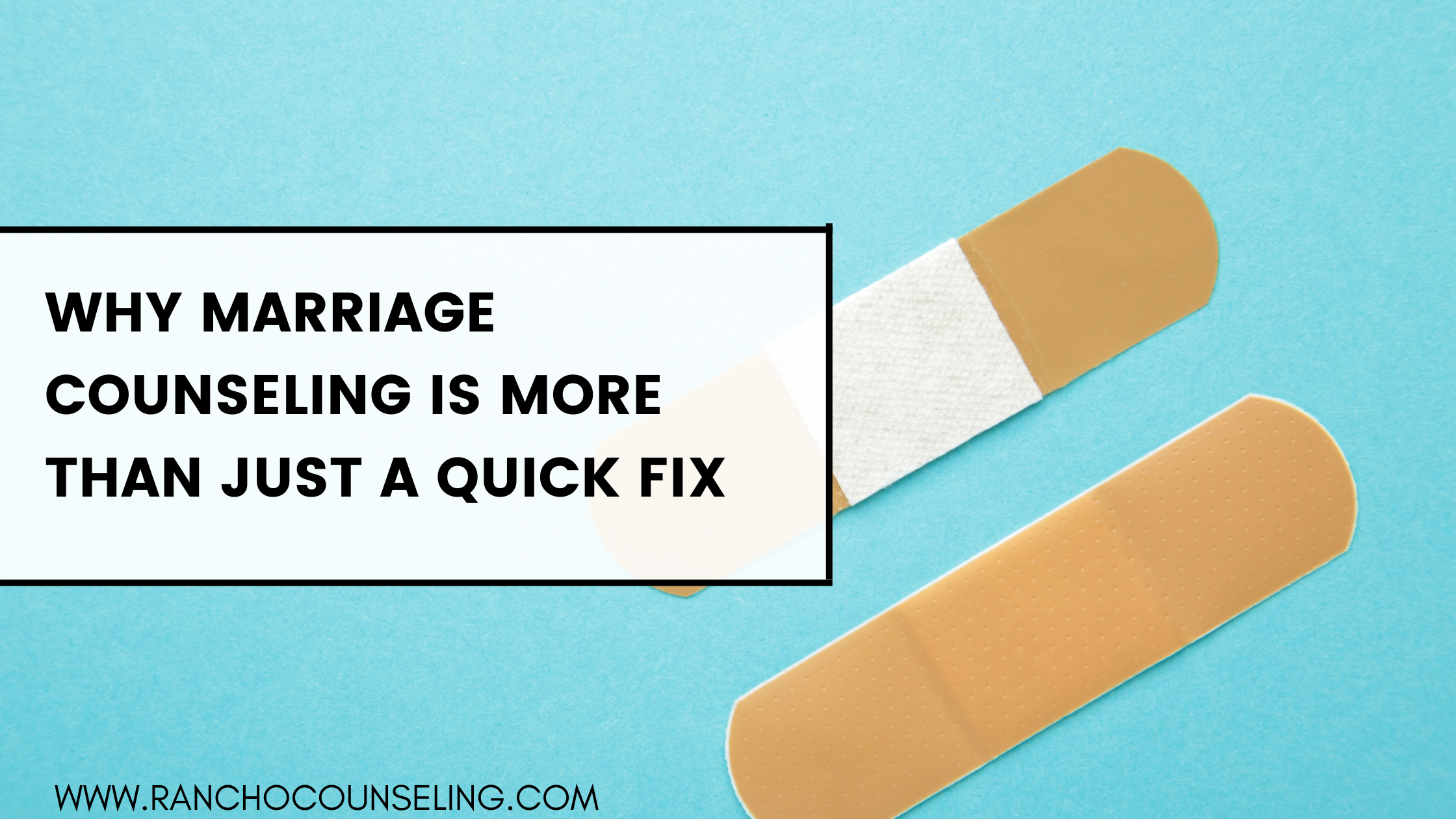
Marriage Counseling Rancho Cucamonga: Why Marriage Counseling Is Not a Quick Fix
Marriage counseling isn't a quick fix. Learn why lasting relationship change takes commitment and how couples in Rancho Cucamonga can create deeper connection through therapy.
"Five minutes to freedom."
"15 minutes a day to make six figures."
"Change your entire life with this hack."
I don't know about you, but my Instagram feed is FULL of clickbait titles like this. My email inbox is also packed with headlines promising quick and effortless transformation.
Social media and marketing are designed to grab our attention and pull on our heartstrings. People want to sell us on the idea that we aren't good enough without whatever they have to offer.
The Truth About Marriage Counseling in Rancho Cucamonga
The therapy space is a little different.
I'm not a coach. I'll never claim to be a guru, and I'll never splash photos of me and my husband across the internet asking, "Do you want what I have?"
The truth is that anyone can portray their relationship any way they'd like online. Social media is the highlight reel, and anyone who claims that having a great marriage comes easy is leaving out a big part of the story.
The truth is, I don't have a quick and easy way for you to create the marriage of your dreams.
Marriage is like anything else: the grass grows where you water it.
As a marriage counselor in Rancho Cucamonga, I've worked with hundreds—maybe even thousands—of individuals and couples over the last 15 years. Not all of them stay in therapy long-term, and I'd be lying if I told you they did.
The reasons people stop marriage counseling vary. Some don't click with their therapist. Some don't want to make the financial investment. And some are hoping for a quick fix.

Marriage Counseling Requires Commitment
This last reason is probably the hardest for me to see.
When couples begin marriage counseling in Rancho Cucamonga, I try to be as honest as possible about what they can expect. I typically tell couples to plan on being in therapy for at least six months. If they are recovering from infidelity or another major betrayal, the process often takes a year or longer.
These are rough estimates, of course.
Most of the patterns that keep couples stuck in cycles of blowout arguments, silent treatment, defensiveness, and disconnection are rooted in unresolved wounds and past experiences.
When people say therapy isn't working, it's often because looking inward is incredibly difficult. It's much easier to focus on your partner's flaws than to examine your own patterns.
Having a weekly reminder of what isn't working in your relationship can be painful. I completely understand the lack of motivation that can show up when you're having a good day and know that therapy later might require you to look at some heavy things.
It's easy to think that because you've managed a few good days without fighting, everything will be fine.
But how many times have you thought that already, only to find yourselves right back in the same painful cycle?
What Couples Counseling in Rancho Cucamonga Can—and Cannot—Do
Marriage counseling is hard.
Marriage counseling is a commitment.
Marriage counseling will not improve your relationship overnight.
Marriage counseling will only work as hard as you do.
But that's exactly why my clients are some of the bravest people I have ever met.
The couples who stay the course, hunker down, and continue showing up week after week grow stronger and stronger. When they weather the storm together, they often come out on the other side with deeper love, greater intimacy, increased self-awareness, and enormous pride in what they've created together.
Graduating couples from marriage counseling is one of the greatest parts of my job.
During our final session, we reflect on where they started. We talk about the setbacks and victories and celebrate the fulfilling connection they've worked so hard to create.
It's one of my favorite moments as a marriage therapist.

How Brainspotting Can Support Marriage Counseling
Thankfully, there are ways to make the healing process a little easier.
When I work with couples, one or both partners are often struggling with unresolved trauma that becomes activated during conflict. When this happens, I sometimes pause our couples work and meet individually with each partner for one or two Brainspotting sessions to help process those triggers.
The relief many clients experience is significant.
Once those emotional wounds have been addressed, we return to our couples counseling work and are often able to move forward much more effectively.
Before I was trained in Brainspotting, this intersection between trauma and relationship conflict could stall progress for months.
Brainspotting isn't a quick fix.
Clients are still doing hard work. They are still experiencing big emotions and moving through challenging experiences. But instead of carrying those emotions around untethered, they begin processing and integrating them in a meaningful way.
I also end Brainspotting sessions with an expansion spot, helping clients connect with feelings they want more of in their lives—peace, calm, confidence, joy, or excitement. Connecting with these positive experiences in the body can make the healing process feel much more manageable.
Ready for Marriage Counseling in Rancho Cucamonga?
If you're ready to do the work and create a truly transformed relationship, I'd love to help.
Whether you're struggling with communication, emotional disconnection, recurring conflict, or recovering from infidelity, marriage counseling can help you reconnect and build the relationship you both want.
Schedule your free 15-minute phone consultation today, and together we'll determine the best path forward for your relationship.
Alicia Taverner, LMFT, is a licensed marriage and family therapist who helps couples heal after infidelity, years of resentment, and the exhaustion of feeling stuck in the same painful patterns.
Her work helps partners begin to understand each other again, rebuild appreciation, and create lasting change with a focused, supportive approach. Alicia uses brain based techniques, including Brainspotting and ketamine assisted psychotherapy, in an intensive format that gives couples more room to heal without the start and stop of weekly sessions.
Learn more about Alicia’s work with affair recovery intensives, relationship therapy, and ketamine therapy, or visit her About page.

Are you suffering in silence?
How long have you spent struggling in your relationship? How many nights have you spent crying alone in the dark, while your partner sleeps next to you, wondering when or how things will ever get better? How many times have you had the same argument and gotten the same results - retreating to your corner, alone, hurt, broken, and feeling helpless?

How long have you spent struggling in your relationship? How many nights have you spent crying alone in the dark, while your partner sleeps next to you, wondering when or how things will ever get better? How many times have you had the same argument and gotten the same results - retreating to your corner, alone, hurt, broken, and feeling helpless?
My guess is way too many.
But why do we suffer alone, in silence?
I’ve heard a lot of interesting opinions about why people choose not to share what’s going on in their marriage. Things like, “we agreed we’d never talk to our family about our marital problems because we didn’t want anyone to have a negative opinion about our partner.”
I’ve also heard, “It’s not always bad so I’m afraid it will sound like I’m just trashing my partner.”
Along with other things like:
“People will judge me.”
“People would be shocked if they knew how bad things are.”
Our Western society teaches us in so many ways that we should suffer in silence. If you’ve ever been told as a child to go to your room because you were having big emotions, then it’s really easy to internalize the belief that your emotions are too much and that you should not burden others with them.
Most parents of the 70’s, 80’s, and 90’s weren’t equipped with the skills of conscious parenting and were likely so uncomfortable with their own emotions that they couldn’t deal with ours. They weren’t privy to the research we have now that shows that stuffing and suppressing emotions actually leads to higher levels of anxiety and depression.
But one thing that I’ve learned in doing this work, and in my own healing is that suffering alone can only get you so far. And it isn’t very far.
It's difficult to undo those patterns that you’ve learned in your childhood, or push past the myths of talking about problems in your marriage. It’s not easy to reach out and tell someone that you don’t have things under control. It’s humbling, and it’s hard.
It can feel like no one will ever understand the nuances of your relationship. It's scary to open up and talk about what’s going on because you might be afraid that talking to a therapist might force you to leave or make other life-altering decisions.
Unless you’re in physical danger, a good therapist will not tell you that you should end your relationship. That’s not our job.
If you come to couples therapy saying that you want to fix the relationship then a good couples therapist will be focused on helping you do that.
Talking about the pain you’re feeling in your relationship can make things feel more real, and I know how scary that can be. But once you put it all out there, it can feel so relieving, and when you see a great couples therapist, you will truly understand that you are not alone.
One of my favorite parts of the therapy process are the first few sessions. I know that couples are uncomfortable sharing what’s really going on behind closed doors. But one of my greatest gifts is instilling hope and letting couples know that they aren’t alone.We’ve seen some really difficult issues in my practice. But my staff and I have helped so many couples weather those difficult storms and create amazing, healthy, connected relationships that surpass what people even think is possible when they first sit down on the couch.
We also have a formula for success that is backed by tons and tons of research! The Gottman Method is one of the most effective tools for helping couples improve their marriages. So you dont just come in and see how things go.
Our staff take the time to truly understand your relationship and each of you as individuals. We start with a couples session to get a sense of the issues you’re struggling with and also conduct a relationship history - we ask about the significant events that have happened in the relationship.
After that, we do an individual session with each partner to get a sense of your personal histories and backgrounds. These play an important role in the way you communicate with one another.
We also send out the Relationship Checkup - an extensive background questionnaire that will measure various aspects of your relationship and communication patterns.
All of these components give us a really good picture of where your strengths are as a couple as well as the areas that can use improvement.
Once we collect all of the important background information we sit down with each couple and show them all of the components the research tells us are required for a happy, healthy relationship. We show each couple where their strengths are, along with their weaknesses and areas that we will be focusing on going forward.
Every couple that works with us knows exactly what their sessions will be focused on because they get a print-out of all of their strengths and weaknesses. There’s no guess-work. Our therapists get to work and help couples reach their goals. They focus on the issues and help couples create amazing, joyful, intimate, connected marriages.
You don’t have to suffer alone. Once you put voice to what's happening the spinning in your head will stop. You can start to see the light at the end of the tunnel.
If any of this sounds like you, I want to help. Imagine what it will feel like moving into Fall feeling like you REALLY want to cozy up to your partner. Imagine starting 2024 with a clear vision for the future of your relationship AND a supportive therapist behind you as you take those scary steps forward.
Picture how connected you'll be this time next year after pushing past your fears - of failure, of not knowing where to start, of anyone knowing what’s really going on in your marriage - and seeing all of the progress you've made together.
You'll be so proud of your relationship and you would have spent the last year learning, healing, connecting, and creating an unstoppable, deep, intimate bond and gained communication tools that you will have for the rest of your lives together.
The things we teach couples take time and practice to implement, but once our couples understand what is under their behaviors, they begin to experience lasting change. They create more intimacy and their love continues to grow even after they graduate from therapy.

Holding onto hope for your Marriage: How therapy can help
It can often seem like giving up and asking for a divorce is the easier thing to do. The task of doing therapy and showing up weekly can feel really daunting when you don’t know what to expect or where to even begin.

When couples finally reach out and call us for the first time, most of them are hopeless.
They feel like they’ve tried everything, and they are exhausted from having the same fights over and over.
Once you’ve decided that you’re going to reach out to a therapist in your area that can also be a confusing task. Many therapists don’t specialize in work with couples or they don’t take your insurance. Couples therapy tends to be a specialized service not covered by some health insurance plans, however working with a couples therapist who truly loves this work and dedicates their career to helping couples makes a HUGE difference in the results you’re going to receive.
Many times when people call me I hear things like, “this is our last resort, we keep trying but nothing is working and we want to be able to say we’ve tried everything, so if therapy doesn’t work, then I guess it’s time to throw in the towel.”
It can sometimes seem like giving up and asking for a divorce is the easier thing to do. The task of doing therapy and showing up weekly can feel really daunting when you don’t know what to expect or where to even begin.
The unknown is scary - I totally get it! But when couples call us for a free 15-minute phone consultation I walk them through our process and answer any questions they might have.
The greatest gift we give our couples at Rancho Counseling is that our therapists are the holders of hope.
⭐️ Many times it’s our job to keep being that North Star of truth that says, “you can do this! Just keep going, you’re making progress!”
For me that’s the best part of being a therapist - Holding hope for people when they’ve lost it.
If you’re losing hope, I want this to be a reminder that you can do this! You can make the changes you need to have the relationship you’ve always dreamed of!
It’s not always easy, and it does take self reflection and work. But it’s totally possible when you meet the right people who are experts in helping couples create amazing connections with one another!
Don’t lose hope my friends! We’re here and we are so happy to help 💕 We have a couple different options for working with us including couples therapy and also our upcoming 7 Principles Workshop so check out our offerings!

Keep your criticism to Yourself!
Criticism is like a match, and can ignite a conflict into a huge blow up. Keep reading to find out how to identify when this is happening in your marriage and how to counteract this habit.

Criticism may start out as a way to rib or joke with your partner, but it can start to happen more often than not and without you even realizing that’s what you’re doing.
I see it a lot in relationships that are on the rocks. Criticism is one of the 4 Horsemen of the apocalypse, according to the Gottman Institute, and is one of the greatest predictors of divorce.
The couples that I work with sometimes have no idea the impact that it can have on their marriage in the long run which is why I want to bring it to your attention today.
Criticism usually begins with the word “you,” and often also includes words like, “always” and “never.”
“You never do the dishes when you say you’re going to! You’re so lazy!” ::Heavy sigh::
Criticism attacks your partner’s character and leaves little room for a productive response or conversation. If you think about it though, it makes total sense - do you ever respond to someone telling you what a shitty job you’re doing at something with an open heart, or a, “wow! Thanks for pointing that out for me, I’m totally going to start doing the dishes now…”
Absolutely not!
Criticism actually does the opposite. It’s like a match, and can ignite a conflict into a huge blow up. This is because our natural inclination is to respond to criticism with defensiveness. It doesn’t elicit warm fuzzies, it makes us want to shut down, fight, or point out all the ways your partner is falling short (defensiveness). The bottom line is - it’s uncomfortable.
Have you ever heard the saying, “you catch more bees with honey?” This is precisely the approach you should be taking with your partner instead.
Talking from a place of how you feel about a behavior is so much more effective and will put your partner in a much less defensive place.
Criticism should be replaced with using I-statements and making specific requests.
Example: I feel hurt and lonely when I’m the only one doing the housework. Can you help me by picking up the kids' toys and doing the dishes when I’m working late?
The need to criticize is often the sign of an unmet need. If you stop and take a moment before you lash out at your partner ask yourself, “what is my need here?” If your need is for support then ask specifically for that support.
Using an I-statement to express how not having your need met makes you feel, makes your feeling hearable. We can hear our partner say when they're hurt, sad, or lonely. Those feelings get lost in translation though when they are hidden behind criticism.
If you feel criticism running rampant in your relationship we are here to help! Click here to set up a free 15-minute phone consultation, or join us for our upcoming 6-week, 7 Principles for Making Marriage Work class beginning in March, 2023. Click here for details and answers to frequently asked questions about this upcoming workshop.